I have been programming for almost ten years, and I have to admit: before AI, it was easier to sense how much you know and how much you do not. A junior knew that they did not know. A senior had production scars and a calm voice. Experience boundaries were readable, because they were visible in the code, in the conversation and in the way of thinking.
In the AI era those boundaries have blurred. Everyone "uses AI", everyone ships similarly looking code, and a declaration costs nothing. How do you determine your level of experience today, when the model writes the code and the human directs the process?
I look for the answer in practice: I work with coding agents daily, from small automations to production deployments. And that is where this post comes in.
mega.dev and the Assessment as a bonus 🎓
MEGA is a four-week program (starting October 26) taught by Kent C. Dodds, Angie Jones, John Lindquist and Theo Browne, with the whole thing architected by Adam Gospodarczyk (overment) - the man behind AI_Devs, who has taught AI to thousands of Polish developers. Behind the project stand BRAVE (Grzegorz Rog) and Badass Courses (Joel Hooks). The live where I saw all this was co-hosted by Adam and Grzegorz. In short, they teach working with agents: concrete, narrowly defined tasks, short conversations, knowledge goes into files that outlive every session, and scale comes from the number of agents, not the length of a chat. I am considering joining, and in the meantime I used what I consider a bonus of that ecosystem: the MEGA Assessment.
It is not a quiz and not a synthetic test with a prepared answer. The Assessment scanned my real work history with agents: what the agent received as input, what it returned, how corrections were given and what survived from the work. Instead of an "I use AI" claim, you get a measurement of how you actually run the collaboration.
One thing tipped my curiosity, because it was the first test of this kind I had ever seen. I searched the web with exactly this question in mind and found nothing similar that works on authentic data, meaning your real work history. Everything I found measured you in comfortable conditions: a sandbox, a made-up task, a demo project staged for review, or something along those lines. Not once a meeting with real work history. MEGA walks into what has already happened and evaluates your habits where they had consequences. That is a different kind of evidence.
My numbers 📊
- 77 days of working with agents (June 25 - September 9, 2026),
- 95 sessions,
- 172 real episodes, complete units of work,
- 23 out of 24 work-style traits measured.
The sample was broad: 48 documentation episodes, 36 in analytics and diagnostics, 24 feature deployments, 15 research tasks. On average 2-3 concrete tasks a day for almost three months.
The volume dilemma 🧮
A lot or a little? Developers like counting lines of code, and there are no lines here - on purpose. Volume has stopped meaning anything, because the model writes the code. The human designs the process: splits the problem, sets boundaries, verifies results and keeps decisions from dying in conversation. That is why the Assessment measures the way of working, not keyboard output.
My card: The Memory Lock 🔒
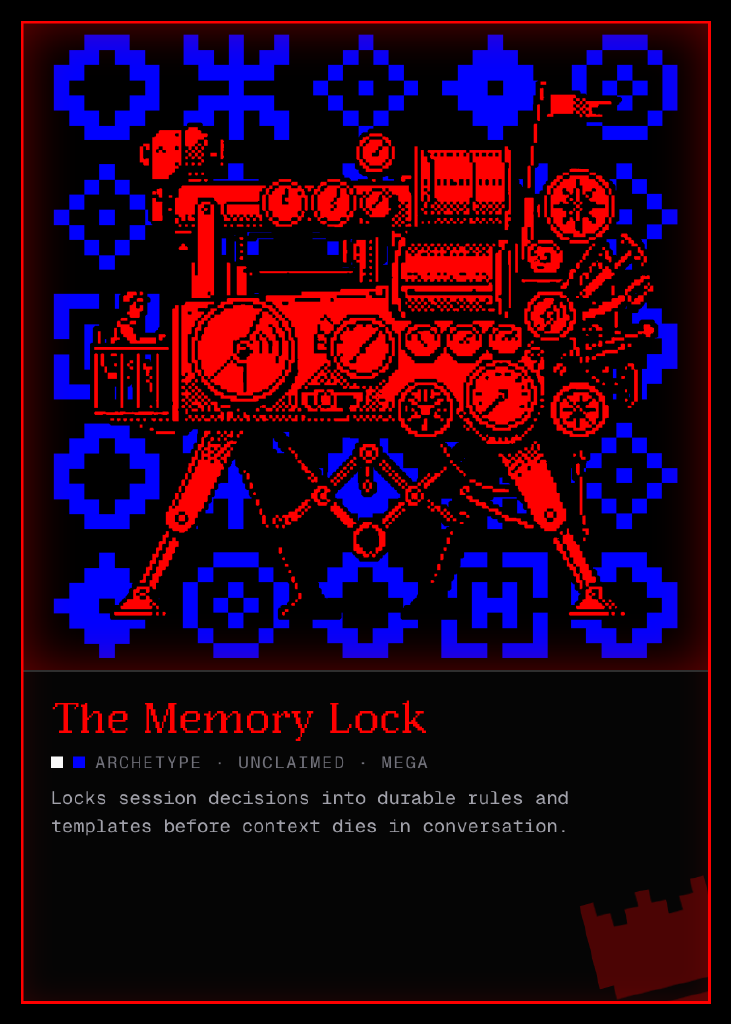
Locks session decisions into durable rules and templates before context dies in conversation.
In practice, this is the most valuable thing I did for my own productivity this quarter.
The strongest patterns 💪
Fractions like 72/72 are not a success counter. They are a consequence: every time the situation occurred, the habit fired.
- 44/44 - decisions land immediately in project rules and templates instead of dying in chat.
- 72/72 - context anchored in artifacts (files, specs, reports), not in stories from memory.
- 68/68 - precise, evidence-backed feedback on corrections, not "fix this".
- 72/74 - evidence at the point of decision, before the decision is made.
- 8/8 - lessons from mistakes come back as future rules.
The other side of the coin 🪞
It would be dishonest to show only the winning side. The report counts 147 corrections and 101 repeated instructions. Short repair loops instead of the "fire and forget" dream.
The most valuable lesson from the whole measurement: measurable acceptance criteria BEFORE launching the agent (15/48, the widest gap in my set). Hard assertions, non-negotiable boundaries and a test the agent runs itself before calling the task done. The second area to improve is proactive delegation (8/22): research, review or verification is often worth handing to an agent instead of doing it yourself.
My daily driver 🛠️
My main coding agent is Droid by Factory (the same one that helps me maintain skladmuzyczny.pl, my portfolio and MCP harnesses). IMO simply the best :) Around it: agentic workflows, MCP servers, custom skills and the "context in files, not in conversation memory" rule. The Assessment confirmed it with numbers, not opinions.
A baseline, not a medal 🎯
To be clear: this is process evidence, not a ranking. Nobody can provide comparisons to others here.
But the essence is one sentence: a test like this is a useful way of showing how you work with AI tools today. On the live we heard that the assessment shows where you are on the road to MegaDev. My take goes a step further: such a result belongs in a CV or a job application as proof of how you work, not how you declare you work. Anyone can type "I work with AI" into a CV in 5 seconds, and it proves nothing. Data from your own history cannot be typed in - it costs months of real work. The difference between a declaration and evidence is today the difference between noise and signal.
In 2-3 months I will repeat the measurement and compare results, especially acceptance criteria and proactive delegation. We will see whether the habits actually moved.
Full result: mega.dev/you/LtnBnIFFFjxBmArIkxRiewfbud9_4QbwKvDB5XjPkXw
Thanks to Adam and Grzegorz for the live session and for a tool that shows what kind of developer you really are, not the one you declare yourself to be.