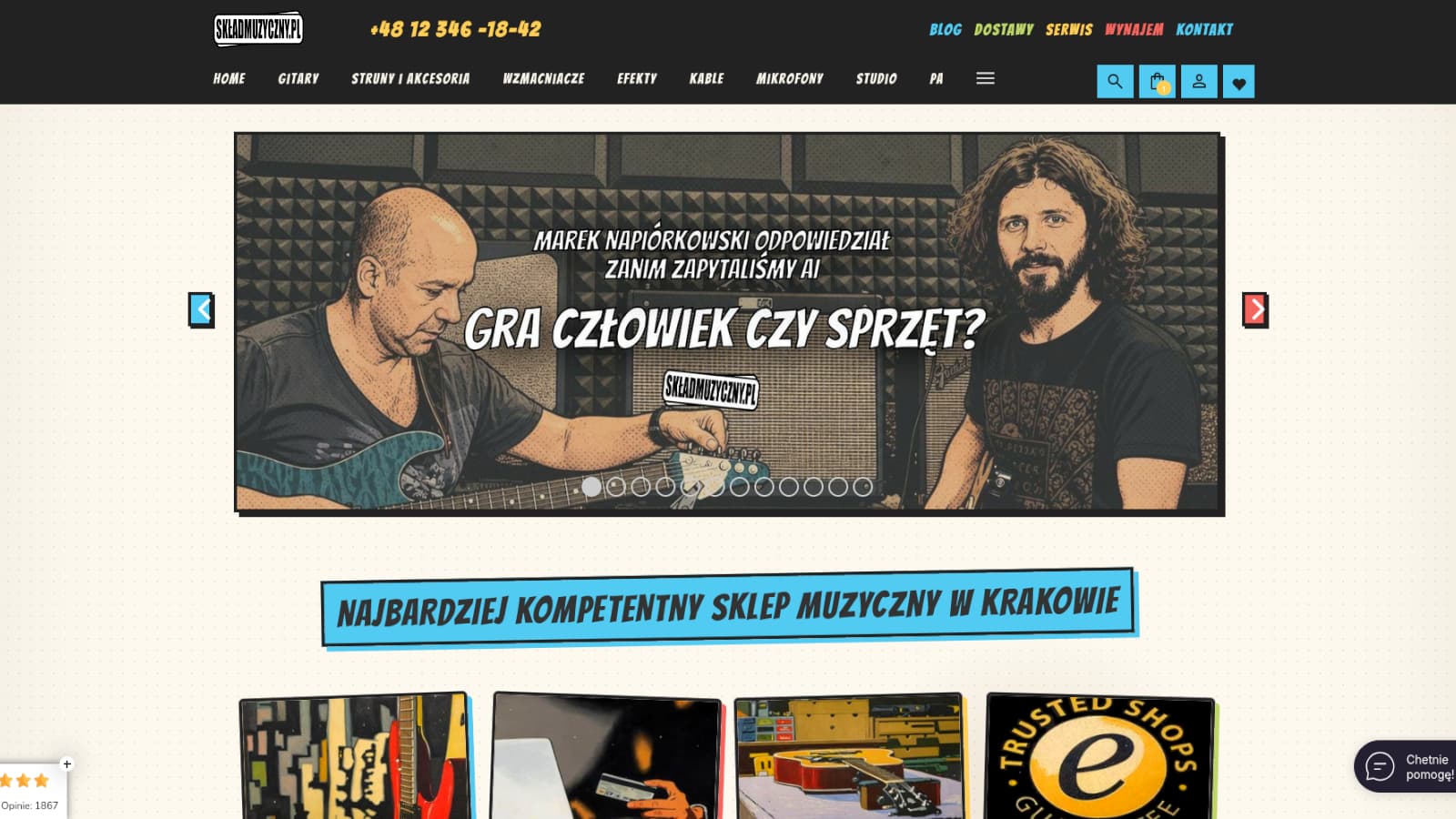
Groove-2026: A distinctive e-commerce design fused with rigorous CSS engineering and accessibility (WCAG)
Groove-2026 is a theme created from scratch for the SOTESHOP e-commerce platform. The project combines a standout “Golden Age Sunday Strip” (pop-art / vintage comic) aesthetic with modern coding standards: fully modular CSS, a Design Tokens architecture, and high accessibility (WCAG AA/AAA)—all delivered within a demanding legacy environment (Symfony 1.x, PHP 7.4).
📋 Project metrics
- Status: Completed (ready for production install)
- Role: Theme Developer / Front-End Architect
- Scope: Reworked 197 Smarty template files and refactored the entire CSS stack
- Business goal: Boost conversion through memorable design and better UX/SEO via performant, accessible code.
🚀 Project evolution (Theme Workflow)
- Audit and inventory (Baseline) — initial code review surfaced critical “spaghetti CSS,” including 444 uses of
!importantand a total scatter of pixel-based values. - Design Tokens architecture — defined a consistent, canonical scale of CSS variables for spacing (
--space-*), typography (--fs-*), radius, and UI elements (e.g., bold comic border--border-comic). - CSS modularization — split the huge monolithic stylesheet into 7 smaller, dedicated modules (e.g., separate files for basket and blog).
- Legacy integration (Smarty loader) — implemented a layered loader (
_css_loader.html) that surgically bypasses SOTESHOP’s aggressive View Cache and only loads the styles needed per view.
🎯 Business problem
Long-lived e-commerce platforms often look generic. Trying to stand out risks performance loss. Years of accumulated code created massive technical debt, slowing any marketing changes.
❌ Pain points and operational challenges
- Spaghetti CSS & tech debt: 444
!importantoverrides blocked predictable development. Ad-hoc spacing and sizing ruined consistency. - Monolithic weight: A single huge CSS file loaded on every page hurt rendering and Core Web Vitals.
- Legacy constraints: Working with an end-of-life framework (Symfony 1.0.19) and strict MySQL mode; no modern bundlers, relying on custom scripts and Smarty templates.
- Production migration risk: Needed to update ~200 files (templates, layouts, plugins) and clear cache correctly without store downtime.
💡 Why it works (engineering approach)
- Bold vintage comic aesthetic: Instead of glassmorphism, we used high contrast—cream backgrounds (
#fdf9ef), hard offset shadows (6px 6px 0 #222), and strong accents (yellow, cyan, red) for a memorable brand personality. - Design Tokens system: Unified code via
:rootvariables. Post-refactor, files include 300+ occurrences of--space-*plus standardized--fs-*and--lh-*scales. - Optimized CSS distribution: Product listing CSS is only 4.7 KB, and blog styles just 608 bytes—each injected conditionally, only where needed.
- Native A11y/WCAG support: Implemented skip links, unified focus rings (
--focus-*), modal focus trapping (aria-modal), and screen-reader-friendlyaria-liveregions.
📈 Impact (ROI)
The rebuild shows that even older infrastructure can support a fast, modern frontend.
| Metric | Effect | Business value |
|---|---|---|
| Codebase quality | Removed hundreds of !important, ~95% tokenization of core CSS | Dramatically faster iteration for future changes |
| Performance | Reduced style overhead via conditional module loading | Better Core Web Vitals and improved SEO scores |
| Accessibility (A11y) | Keyboard/screen-reader support (min. 4.5:1 contrast, aria-labels) | Inclusive experience; easier navigation |
| Scalability | Custom installation ecosystem (shell scripts) | Safe iteration across DEV/PROD without “breaking” the store |
“A token-driven, conditionally loaded CSS architecture breathed new life into legacy code, blending unique design with performance.”
🛠️ Architecture & tech stack
- Core & Backend: SOTESHOP (Symfony 1.0.19, PHP 7.4), MySQL 5.7, Propel ORM.
- Templating system: Smarty (version 2.6.33) - slots for plugin injection and conditional style loading.
- Frontend / Styling: Vanilla CSS using native variables (CSS Custom Properties), Bootstrap 3, jQuery (legacy-compatible).
- DevOps / Tooling: In the DEV environment Docker (fully containerized environment), automated bash installation scripts.
🚀 Summary
Groove-2026 proves that mature, long-lived e-commerce software doesn’t have to block modern UI/UX. Through careful engineering, we built a theme that is visually distinctive yet lightweight to maintain, giving the brand a solid edge over template-driven competitors.