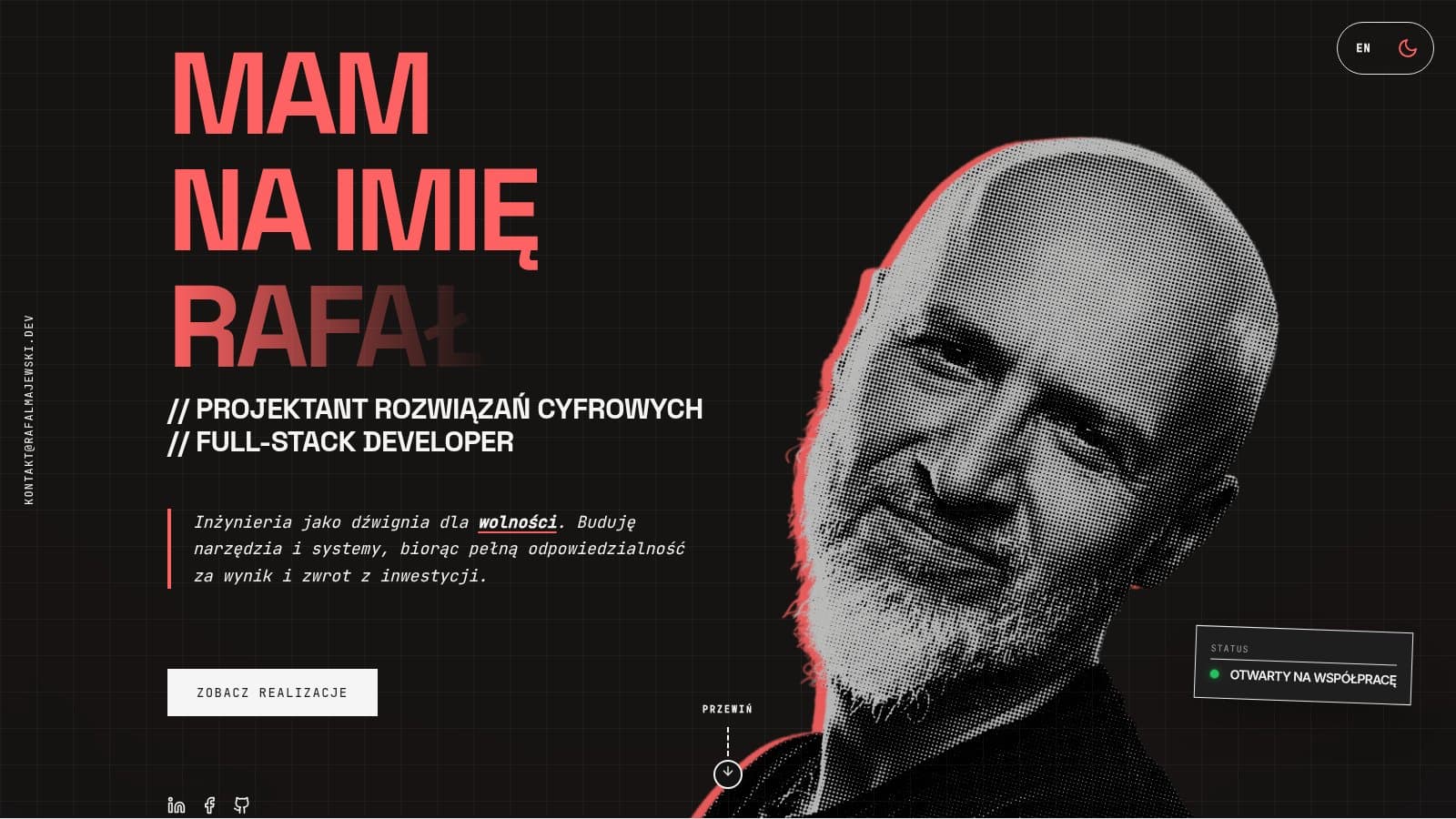
Developer Portfolio: An architecture based on MDX, i18n, and Next.js 16
A personal portfolio is a developer's ultimate proving ground. Instead of reaching for ready-made WordPress templates or heavy Headless CMS systems, I built an ultra-lightweight application from scratch in Next.js. The project combines a modern tech stack (React 19, App Router) with full internationalization (i18n) and a content system based entirely on Markdown/MDX files.
📋 Project metrics
- Go-live: Early 2026
- Status: Continuous Deployment
- Role: Lead Architect / Developer
- Goal: Create a performant, secure, and maintainable platform to showcase projects, 100% managed via the Git repository.
🚀 Project evolution (Architecture)
- Content system (MDX): Moving away from databases in favor of
next-mdx-remoteand frontmatter (gray-matter). Content is parsed at build-time, guaranteeing instant loading. Schema validation via Zod — frontmatter errors caught before build. - Internationalization (i18n): Implemented
next-intlto handle multi-language routing at the App Router level (dynamic/[locale]paths). Full PL/EN parity for projects, blog, and transcriptions. - Atomic Design: Components split into atoms → molecules → organisms → templates. A consistent vintage technical blueprint design system.
- Design System & Theming: Styling powered by Tailwind CSS (v3) with native light/dark mode toggling via
next-themes. - Feature scope: Homepage with hero, project list (case studies) with hero images, blog, transcriptions, legal pages (privacy policy, terms), newsletter with server actions and rate limiting.
- SEO & Social: Dynamic metadata, JSON-LD (
schema-dts), sitemap, robots.txt, dynamically generated OG images (next/og), hero images propagated to OpenGraph and Twitter Cards. - Quality & Testing: A rigorous setup using Vitest, React Testing Library, ESLint, and TypeScript, catching bugs well before the build phase.
🎯 Business problem
Presenting developer projects requires a platform that itself serves as proof of the creator's skills. Typical CMS-based portfolios incur database hosting costs, require plugin updates, and often suffer from mediocre performance, which negatively impacts Core Web Vitals and first impressions.
❌ Pain points and operational challenges
- Management overhead: Clicking through CMS panels just to add a short project is a waste of time.
- Language silos: Maintaining consistency between Polish and English versions gets chaotic without a solid i18n mechanism.
- Performance (SEO): Resource loading delays or Client-Side Rendering (CSR) discourage Google bots.
💡 Why it works (engineering approach)
- Git-based CMS: Projects are kept as
.mdxfiles directly in the repo. Adding a new project is just a git push of a text file — total version control and perfect Developer Experience (DX). - Static & Server Rendering: Leveraging Next.js Server Components (RSC) and pre-rendering generates static HTML. Only the bare minimum of JavaScript is sent to the browser.
- Integrated SEO: Dynamically generated
sitemap.ts,robots.ts, and JSON-LD support (schema-dts) allow search engines to deeply understand the portfolio's structure. - Solid type foundations: Combining TypeScript with frontmatter schema validation using Zod.
📈 Impact on development (ROI from architecture)
An "everything-in-code" approach minimized costs and maximized publishing speed.
| Aspect | Implemented solution | Benefit for creator / user |
|---|---|---|
| Content management | MDX files with schema validation (Zod) | Publishing time cut to seconds, working within the IDE |
| Accessibility / i18n | next-intl routing (/pl/projekty, /en/...) | Full international SEO coverage with a single codebase |
| Stability | Continuous Integration (CI) via Vitest + ESLint | Stress-free deployments without breaking production |
| Infrastructure / Cost | Self-hosted VPS with Dokploy (Docker + Traefik) | Full control, zero external hosting costs |
"Switching to an MDX and App Router architecture eliminated CMS overhead, granting full control over code and content straight from the IDE."
🛠️ Architecture & tech stack
- Core: Next.js 16.1.1 (App Router, Server Components), React 19
- Language: TypeScript 5 (Strict Mode), Zod schema validation
- Styling: Tailwind CSS 3, PostCSS, Lucide React (icons)
- Component architecture: Atomic Design (atoms → molecules → organisms → templates)
- Content:
next-mdx-remote,gray-matter,remark-gfm - i18n & Meta:
next-intl,next-themes, dynamic metadata - SEO & Social: JSON-LD (
schema-dts), sitemap, robots.txt, dynamic OG images (next/og), hero images in OpenGraph/Twitter - Accessibility: Semantic HTML, skip link, focus-visible, ARIA, WCAG contrast
- Infra: Self-hosted VPS with Dokploy (Docker + Traefik), shared with other projects
- Code Quality: Vitest, React Testing Library, ESLint, Prettier, Dependency Cruiser
🚀 Summary
The current iteration of this portfolio proves that advanced architecture doesn't have to be overcomplicated. Using MDX alongside Next.js 16 provides a powerful, scalable solution that combines the freedom of writing in Markdown with the capabilities of the modern React ecosystem.